Can you claim dental treatment in India on your insurance?
Short answer: Sometimes, and it depends on the policy, not the country. Most UK, US, Canadian and Australian dental plans reimburse treatment received abroad under their out-of-network rules, paying a percentage of the same procedure code they would pay at home — which, on Indian prices, often covers most or all of the bill. What almost never works is claiming without the right paperwork, so get an itemised invoice with procedure codes, the dentist\u2019s registration number and dated clinical records before you fly home.
General information, not insurance advice. Check the wording of your own policy or ask your insurer before you travel.
What your claim needs
| Document | Why it matters |
|---|---|
| Itemised invoice with treatment codes | Insurers reimburse by procedure code, not by description |
| Dentist name, qualification and registration number | Proves the treatment was done by a licensed practitioner |
| Clinic details and dates of each visit | Ties the treatment to your travel dates |
| Pre-treatment and post-treatment X-rays | Evidence the treatment was clinically necessary |
| Proof of payment | Card statement or receipt in your own name |
| Pre-authorisation, where the policy asks for it | Some policies refuse claims that were not pre-approved |
Ask your insurer these four questions before you travel
One: does the policy cover treatment received outside the country, and at what percentage? Two: is pre-authorisation required, and how long does it take? Three: what are the annual maximum and the per-procedure limits? Four: which procedure coding system should the invoice use? Getting these in writing before you book turns a maybe into a yes, and takes about one phone call.
Where medical tourism cover fits in
Standard travel insurance covers emergencies, not planned treatment, so a routine dental trip is outside it. Dedicated medical-tourism cover exists and typically pays for complications, an extended stay or a return flight if something needs redoing — not for the treatment itself. It is worth pricing for implant or full-mouth work, and rarely worth it for a single crown. Plan the trip itself with the trip planner and see when to travel.
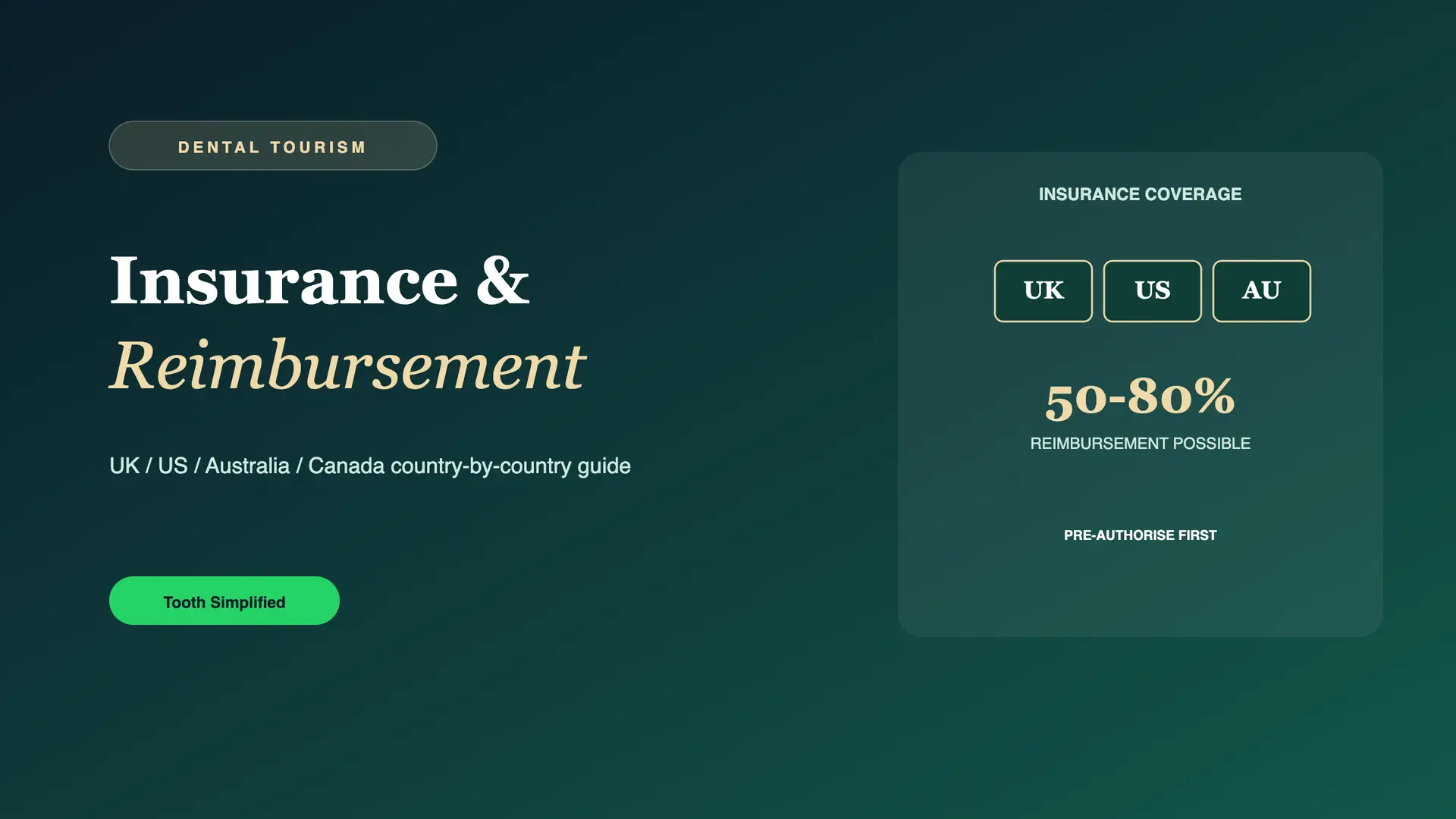
Yes, you can often claim back some or all of your Indian dental treatment — but it depends on your country and the type of plan. Most UK private dental insurers and many US/Australian dental plans will reimburse out-of-network treatment at the same percentage they would pay at home (typically 50–80%). Always pre-authorise with your insurer, keep itemised receipts in English, and obtain detailed treatment records before leaving India.
One of the most common questions from international dental tourism patients is: “Will my insurance back home pay anything for treatment I had in India?” The honest answer: often yes, but the process and amount vary widely by country and policy. This guide breaks down what you can claim back, what paperwork to collect, and the country-specific quirks.
The Universal Rule: Pre-Authorise Before You Travel
Whatever country you live in, the single biggest mistake patients make is treating in India first and asking their insurer second. Always:
- Contact your insurer before booking flights and ask: “Do you reimburse out-of-country / out-of-network dental treatment?”
- Get the answer in writing (email is fine).
- Ask for a pre-authorisation based on your treatment plan and quote from the Indian clinic.
- Confirm what documentation they require for the post-treatment claim (receipts, treatment notes, X-rays, dentist’s registration).
- Confirm whether they need itemised invoices or accept a single total.
Get the pre-authorisation in writing — it’s your safety net when filing the claim.
United Kingdom: Private Dental Insurance Claims
The UK has a clear two-tier system — NHS and private dental insurance. Here’s what each does:
NHS Dental Cover
The NHS does not reimburse private treatment abroad. However, the NHS is generally limited to basic restorative work in the UK anyway, so most cosmetic patients are already paying privately.
Private UK Dental Insurance
Plans like Denplan, Bupa Dental, Cigna and AXA often reimburse overseas treatment at the same percentage as UK private treatment — typically 50–80% up to your annual policy limit. Required documents:
- Itemised invoice in English with each procedure listed
- Treatment plan / consent forms
- Dentist’s name and registration / qualification details
- Clinic’s registration number
- Pre- and post-treatment X-rays / photos where applicable
- Receipt showing payment
Many UK insurers cap annual dental claims at $2,050–$4,050, so a full mouth treatment may exceed your cap — but you can still claim up to the limit.
United States: Dental Insurance & HSA / FSA
Out-of-Network Reimbursement
Most US dental insurance plans (Delta Dental, Cigna Dental, Aetna Dental, MetLife) reimburse out-of-network providers at the same percentage as in-network — typically 50% for major work (crowns, implants) and 80% for basic work (fillings, cleaning). The patient pays the Indian clinic in full, then submits a claim for reimbursement at their plan’s allowed amount.
You’ll need the Indian clinic to provide an itemised invoice with CDT procedure codes (the American Dental Association coding system). Most Indian clinics treating international patients can produce these on request.
HSA / FSA Accounts
This is the most overlooked tax advantage. Money in a Health Savings Account (HSA) or Flexible Spending Account (FSA) can be used for dental treatment anywhere in the world — including India. That means treatment is paid for with pre-tax dollars, saving you 22–37% depending on your tax bracket. Keep your itemised receipts as IRS-eligible medical expense documentation.
Australia: Private Health Insurance Extras
Australia’s “Extras” insurance (dental, optical, physio) is widely held. Most major Extras providers (Bupa, HCF, Medibank, NIB) reimburse dental treatment received overseas under their international claims policies. Typical features:
- Reimbursement is calculated based on the schedule of fees for the equivalent Australian procedure — not the Indian price.
- Most plans have annual sub-limits for major dental ($800–$2,500/year).
- Receipts must be translated into English (most Indian clinics issue in English by default).
- Australian Dental Association (ADA) item numbers help the claim processing.
Submit through your insurer’s overseas claims portal with the itemised invoice and treatment notes. Reimbursement typically takes 2–4 weeks.
European Union & Cross-Border Healthcare
EU/EEA residents may be eligible for partial reimbursement of treatment received in another EU/EEA country under the Cross-Border Healthcare Directive (2011/24/EU). India is not in the EU, so this directive doesn’t apply to Indian treatment — but private EU dental insurance often does cover non-EU treatment. Check policy wording carefully.
Practically: most EU patients fund Indian treatment privately and accept the saving (still 60–80% cheaper than home) without involving insurance.
Canada: Provincial Plans & Private Insurance
Provincial healthcare plans don’t cover dental treatment in or outside Canada in most cases. Private dental plans (Sun Life, Manulife, Great-West Life) generally do reimburse out-of-country dental treatment at the plan’s allowed schedule of fees, with the same documentation requirements as the UK and Australia.
What Counts as Valid Receipt Documentation?
Regardless of country, your insurer will want:
- Itemised invoice showing each procedure with its individual cost (not a single total)
- Procedure dates — one per treatment session
- Tooth numbers using the universal numbering system (FDI or Universal)
- Material details for crowns/veneers/implants (e.g., “e.max porcelain veneer”)
- Dentist’s full name, qualifications and registration
- Clinic address and registration
- Payment receipt showing currency, amount and method
- Pre- and post-treatment X-rays / records where requested
A reputable Indian dental clinic with international patient experience will provide all of this in English without prompting.
Tax Deductions: Often Overlooked
Beyond insurance, dental treatment is often tax deductible in your home country if your total medical expenses exceed a certain threshold of your income:
- USA: Medical expenses exceeding 7.5% of Adjusted Gross Income (AGI) are deductible. Foreign dental treatment qualifies.
- Canada: Medical Expense Tax Credit can include foreign dental treatment.
- Australia: Dental treatment medical expenses may qualify for the Net Medical Expenses Tax Offset (subject to current eligibility).
- UK: Limited — most dental work is not tax-deductible unless self-employed under specific conditions.
Keep all invoices and translate them into English if needed for your tax filing. Consult your accountant for country-specific advice.
Honest Bottom Line
For most international patients, partial reimbursement (50–80%) is the realistic expectation — not full coverage. Even so, when combined with India’s already lower base prices, the final out-of-pocket cost is often 20–30% of what the same treatment would cost at home. Pre-authorise, document thoroughly, and use HSA/FSA money where available.
Want a treatment plan you can pre-submit to your insurer?
We’ll send you an itemised treatment plan with procedure codes, materials and pricing in your currency — ready to share with your insurance for pre-authorisation. No commitment to book.
“The doctor explained my braces treatment — procedure, duration and results — in full detail.”
Orthodontic patient
“Got my root canal and crown done here — comfortable the whole way through.”
Root canal patient
“My tooth-coloured filling looks so natural you can hardly notice it.”
Restorative patient
Worried about cost? EMI and CGHS options for dental treatment in Delhi-NCR.
Frequently Asked Questions
Can I claim Indian dental treatment on my UK insurance?
In most cases, yes. Private UK dental insurance (Denplan, Bupa Dental, Cigna, AXA) typically reimburses overseas treatment at the same percentage as UK private treatment — usually 50–80% up to your annual cap (often $2,050–$4,050). NHS dental cover does not reimburse private treatment abroad. Pre-authorisation in writing before you travel is essential.
Will US dental insurance pay for treatment in India?
Most US dental plans (Delta Dental, Cigna, Aetna, MetLife) reimburse out-of-network providers at the same percentage as in-network — typically 50% for major procedures and 80% for basic work. The patient pays the Indian clinic in full and submits a claim afterwards. The Indian clinic must provide an itemised invoice with CDT procedure codes.
Can I use my HSA or FSA for dental treatment in India?
Yes. HSA (Health Savings Account) and FSA (Flexible Spending Account) funds can be used for qualifying medical and dental treatment anywhere in the world, including India. Keep itemised receipts as IRS-eligible medical expense documentation. This effectively gives you a 22–37% saving (depending on your tax bracket) on top of the lower Indian price.
How does Australian insurance handle dental treatment in India?
Most Australian Extras insurance providers (Bupa, HCF, Medibank, NIB) reimburse overseas dental treatment based on the schedule of fees for the equivalent Australian procedure — not the Indian price. Annual sub-limits for major dental usually apply ($800–$2,500). Submit through the insurer’s overseas claims portal with itemised invoices.
What documents do I need from the Indian clinic for an insurance claim?
You need: an itemised invoice in English (each procedure listed separately with cost), treatment dates, tooth numbers using FDI or Universal numbering, material details (e.g., “e.max porcelain veneer”), dentist’s name and registration, clinic registration, payment receipts, and pre/post-treatment X-rays where available. Most experienced Indian clinics provide all of this in English by default.
Is dental treatment in India tax deductible?
In some countries, yes. In the US, dental expenses (foreign or domestic) exceeding 7.5% of Adjusted Gross Income are tax deductible. Canada has a similar Medical Expense Tax Credit. Australia’s Net Medical Expenses Tax Offset has eligibility rules. UK tax deductions for dental work are limited. Always consult your accountant.
Should I pre-authorise with my insurance before flying to India?
Yes — this is the single most important step. Contact your insurer with the Indian clinic’s treatment plan and quote, ask whether they cover out-of-country treatment, and get the answer in writing. This protects you when filing the post-treatment claim and avoids surprises.
What if my insurance refuses the claim?
Insurance refusals are usually because of insufficient documentation, treatment not covered under your specific policy, or annual limits being reached. Appeal with additional clinical justification if you believe the refusal is incorrect. The cost saving from Indian treatment (60–80% lower than home) usually means even with no insurance reimbursement, your out-of-pocket is less than fully insured home treatment.
Related Reading
Related guide: dental tourism in India guide.
Explore treatments at Tooth Simplified
Led by Dr. Bandhavi, MDS (Endodontics) — painless, affordable care for local Delhi-NCR patients and international visitors.
Guides you might find useful
- Dental implant cost in Ghaziabad
- All-on-4 vs All-on-6 implants
- India vs Thailand vs Hungary for implants
- Does scaling weaken teeth? (the myth)
- Dental tourism from Canada
- Dental tourism in India — full FAQ
Leave a Reply